How to Clear or Repair a Clogged Underground Downspout Drain
Need Help With a Clogged Underground Downspout Drain?
Is water backing up around your downspout, pooling in your yard, or bubbling out of the ground? The underground pipe may be clogged, damaged, filled with roots, or disconnected.
Call today to discuss your drainage problem and find out whether your underground downspout drain needs cleaning, repair, or further inspection.
Call 313-367-1116When rainwater from your gutters suddenly starts backing up, pooling around the foundation, or bubbling out of the ground several feet away from the house, the problem may not be your gutters at all.
You may have a clogged or damaged underground downspout drain.
These buried drainage pipes are designed to carry water away from your home’s foundation. When they become clogged with dirt, leaves, roots, sediment, or other debris—or when the pipe collapses or separates—the water has nowhere to go.
So, how do you clear a clogged underground downspout drain?
The best approach is to first determine whether the pipe is clogged, disconnected, crushed, or damaged by roots. A simple blockage may be cleared with flushing or drain-cleaning equipment. A damaged underground pipe, however, may need to be repaired or replaced.
Here’s how homeowners can diagnose the problem and determine the right solution.
What Is an Underground Downspout Drain?
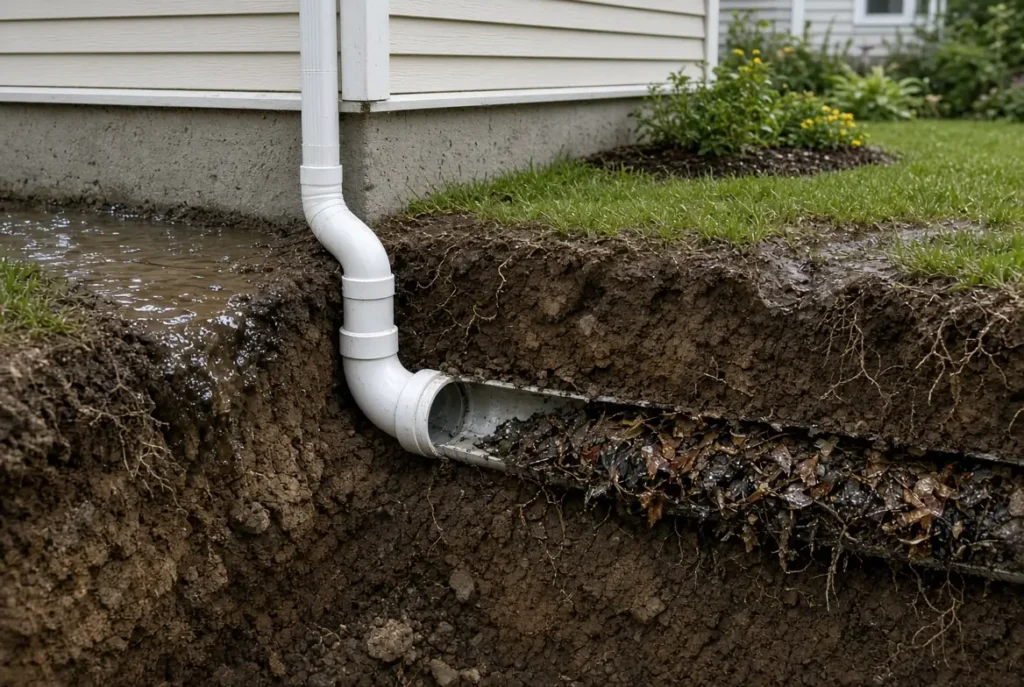
An underground downspout drain is a buried pipe connected to a gutter downspout.
Instead of allowing rainwater to discharge directly beside the house, the system carries water underground to another location.
The outlet may discharge into:
- A pop-up emitter
- A drainage area
- A storm drain
- A dry well
- A drainage ditch
- Another approved discharge point
When the system is working correctly, rainwater should travel through the downspout and underground pipe without backing up.
When something goes wrong, the symptoms can be surprisingly obvious.
How Do I Know If My Underground Downspout Drain Is Clogged?
A clogged underground downspout often reveals itself when it rains.
Common warning signs include:
- Water backing up at the bottom of the downspout
- Water overflowing from the gutter
- Water pooling around the downspout
- A soggy area in the lawn
- Water bubbling out of the ground
- A pop-up emitter that doesn’t open
- Slow drainage after rainfall
- Water coming back toward the house
- Gurgling or unusual sounds underground
- Erosion around the buried pipe
One of the biggest clues is water coming out somewhere it shouldn’t.
If the gutter and downspout are clear but water can’t make it through the underground pipe, the buried drainage system deserves attention.
Why Does Water Back Up Around My Downspout?
A backup can have several causes.
The underground pipe may be:
- Clogged with leaves
- Filled with sediment
- Blocked by dirt
- Crushed
- Disconnected
- Filled with roots
- Frozen
- Improperly sloped
- Damaged by settling soil
The first step is determining whether you’re dealing with a blockage or a damaged pipe.
That’s important because cleaning won’t permanently solve a pipe that has collapsed or separated underground.
Why Is Water Coming Out of the Ground Near My Downspout?
If water is bubbling out of your lawn during or after rainfall, the buried pipe may be blocked or damaged.
Water is looking for somewhere to escape.
If the intended outlet is blocked, pressure can force water through:
- Pipe joints
- Cracks
- Loose connections
- Soil above the pipe
- Low spots in the yard
The location of the puddle doesn’t necessarily tell you exactly where the problem is.
Water can travel underground before reaching the surface.
Why Is My Underground Downspout Drain Not Draining?
A buried drain may stop draining because of a simple blockage or a physical problem with the pipe.
Common causes include:
Leaves and Organic Debris
Leaves can enter through gutters and downspouts, particularly if the system isn’t properly screened.
Dirt and Sediment
Over time, sediment can accumulate inside the pipe and reduce its capacity.
Roots
Tree and plant roots can enter damaged or poorly sealed pipe joints.
Crushed Pipe
Heavy equipment, vehicles, construction, settling soil, or age can damage buried piping.
Separated Connections
Underground pipes can shift or separate, allowing water to escape into the surrounding soil.
Poor Slope
A drainage pipe needs an appropriate route and grade. Low spots can allow water and sediment to accumulate.
Can I Unclog an Underground Downspout Drain Myself?
Sometimes.
If you have accessible cleanouts and the blockage is relatively close to the opening, a homeowner may be able to flush or mechanically clear the line.
But buried drainage systems can be difficult to diagnose.
You don’t want to spend hours forcing water into a pipe that’s actually:
- Crushed
- Disconnected
- Root-filled
- Collapsed
- Improperly installed
If the blockage doesn’t clear easily, finding out why the pipe is blocked becomes more important than simply forcing more water into it.
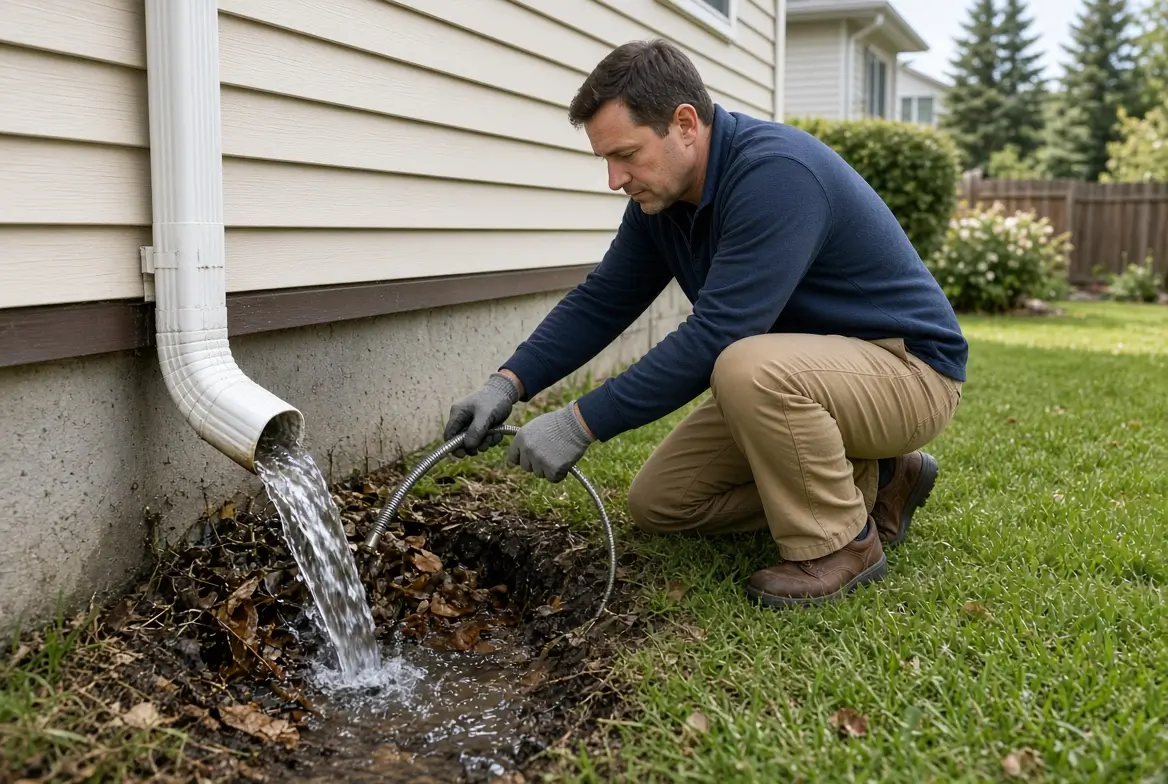
Can I Use a Garden Hose to Unclog a Downspout Drain?
A garden hose may help with a minor blockage near the beginning of the drainage pipe.
However, it isn’t a guaranteed solution.
If the pipe is heavily clogged, a hose may simply push water against the blockage.
And if the pipe is broken underground, adding more water may make the surrounding soil wetter without solving the problem.
A hose is reasonable for a simple first attempt when the system is accessible, but persistent backups usually require a more thorough diagnosis.
Can I Use a Drain Snake on an Underground Downspout?
A drain-cleaning cable can sometimes clear an underground downspout line.
However, the equipment needs to be appropriate for the pipe.
Aggressive mechanical equipment can potentially damage older or fragile piping.
The type, diameter, length, and condition of the pipe all matter.
If you don’t know what type of pipe is buried in your yard, blindly running heavy equipment through it isn’t necessarily the best first step.
Can a Plumbing Snake Clear an Underground Downspout Drain?
It can, depending on the situation.
A drain snake may break through a blockage caused by:
- Dirt
- Leaves
- Sediment
- Small roots
- Organic debris
But clearing a path through a blockage doesn’t necessarily remove everything inside the pipe.
If the pipe is damaged, the clog may return.
That’s why repeated clogging is a sign that the underlying drainage system should be investigated.
Can Hydro Jetting Clear an Underground Downspout?
Hydro jetting uses high-pressure water to clean the inside of a pipe.
It can be effective for certain types of buildup and debris.
However, hydro jetting isn’t appropriate for every underground downspout system.
Before using high-pressure equipment, the condition of the pipe should be considered.
A severely damaged or deteriorated pipe may not be a good candidate for aggressive cleaning.
Cleaning a damaged pipe doesn’t make the pipe undamaged.
If the problem is structural, repair or replacement may be necessary.
How Do I Know If My Underground Drain Pipe Is Broken?
A broken pipe may produce symptoms similar to a clog.
Look for:
- Repeated backups
- Sinkholes or depressions
- Unusually wet areas
- Water surfacing away from the intended outlet
- Soil erosion
- Persistent standing water
- Drainage that works poorly even after cleaning
- A line that repeatedly clogs
If the system has been cleaned and quickly develops the same problem again, there’s a good chance something more than a simple blockage is happening.
Why Does My Downspout Drain Work Sometimes but Not Others?
Intermittent drainage problems can be particularly frustrating.
The pipe may have a partial blockage rather than a complete blockage.
For example, a partially clogged pipe might handle a light rain but become overwhelmed during a heavy storm.
A low section of pipe can also hold water and sediment until enough debris accumulates to restrict flow.
If your downspout only backs up during heavy rain, don’t assume the system is fine.
The problem may simply be showing up when the drainage system reaches its limit.
Why Does My Downspout Overflow During Heavy Rain?
A downspout can overflow because of either a gutter problem or an underground drainage problem.
First check the obvious:
- Is the gutter full of leaves?
- Is the downspout itself blocked?
- Is water actually entering the underground pipe?
If the downspout is clear but water backs up when entering the buried pipe, the underground section may be restricted.
Heavy rain can expose drainage problems that aren’t obvious during smaller storms.
How Do I Find Where My Underground Downspout Pipe Goes?
This can be difficult if the drainage system isn’t documented.
Start by following the visible downspout.
Look for:
- A pop-up emitter
- A visible outlet
- A drainage grate
- A cleanout
- A ditch
- A dry well
- Another connection
If there is no obvious outlet, the pipe may run farther underground than expected.
A professional may be able to use specialized inspection or locating equipment to determine where the buried line runs.
What Is a Pop-Up Emitter?
A pop-up emitter is an underground drainage outlet designed to release water when flow reaches it.
When the system isn’t carrying water, the emitter remains relatively flush with the ground.
During rainfall, water pressure pushes the top upward, allowing water to discharge.
If the emitter is clogged with:
- Dirt
- Grass
- Leaves
- Mud
- Sediment
it may not function correctly.
Before assuming the entire underground pipe is blocked, inspect the outlet.
Why Is My Pop-Up Drain Not Popping Up?
A pop-up emitter may fail to rise because:
- The underground line is clogged
- The emitter is filled with dirt
- The pipe has insufficient water flow
- The emitter is damaged
- The line is disconnected
- The drainage system isn’t properly graded
Clean the visible emitter and check whether water can reach it.
If the emitter remains inactive while water backs up at the downspout, the problem may be farther upstream.
Can Roots Clog an Underground Downspout Drain?
Yes.
Tree and plant roots can enter underground drainage systems, particularly where pipe joints have separated or cracks have developed.
Once inside, roots can trap additional:
- Dirt
- Leaves
- Sediment
- Organic material
The result can be a progressively worsening blockage.
If a buried downspout drain repeatedly clogs despite cleaning, roots should be considered as a possible cause.
How Do I Remove Roots From an Underground Drain?
Root removal may require mechanical drain-cleaning equipment or other specialized methods.
However, removing the roots doesn’t necessarily solve the reason they entered.
If roots are growing through a crack or separated joint, they’ll have an opportunity to return.
For recurring root intrusion, repairing the damaged section may be a better long-term solution than repeatedly clearing the roots.
Should I Dig Up My Yard to Find the Clog?
Not necessarily.
Digging blindly can turn a relatively simple drainage repair into a much larger landscaping project.
Before excavating, determine whether the problem can be located using:
- Inspection
- Drain-cleaning equipment
- Camera inspection
- Locating equipment
- Existing cleanouts
- Outlet inspection
If the exact location of the problem can be identified first, excavation can be limited to the area that actually needs repair.
Can a Camera Find a Clogged Underground Downspout?
A drain camera can be extremely useful for certain underground drainage problems.
A camera may reveal:
- Blockages
- Cracks
- Root intrusion
- Separated joints
- Collapsed pipe
- Standing water
- Debris buildup
Camera inspection is particularly useful when a drainage pipe keeps failing after it has already been cleaned.
Instead of repeatedly treating the symptom, you can find out what’s actually happening inside the pipe.
How Do I Repair a Broken Underground Downspout Drain?
The repair depends on the type of damage.
A damaged section may need to be:
- Located.
- Excavated.
- Cut out or removed.
- Replaced with appropriate drainage pipe.
- Properly connected.
- Backfilled.
- Tested.
If only a small section is damaged, a spot repair may be possible.
If the pipe is collapsed or severely deteriorated over a long distance, replacement may make more sense.
Can I Repair an Underground Downspout Without Digging?
Sometimes.
If the problem is a simple clog, cleaning can often be performed without excavation.
Some specialized drainage repair techniques can also address certain problems with limited digging.
But if the pipe itself is crushed, disconnected, or severely damaged, some excavation may ultimately be necessary.
The goal isn’t to avoid digging at all costs.
The goal is to avoid unnecessary digging.
How Much Does It Cost to Repair an Underground Downspout Drain?
There isn’t one standard price.
The cost depends on whether you need:
- Drain cleaning
- Root removal
- Camera inspection
- Locating
- Spot repair
- Pipe replacement
- Excavation
- Landscaping restoration
A simple clog may be considerably less expensive than replacing a long section of buried pipe.
Getting the problem diagnosed first can prevent homeowners from paying for unnecessary excavation or replacement.
Is It Better to Clean or Replace an Underground Downspout Drain?
If the pipe is intact and simply clogged, cleaning is usually the logical first step.
If the pipe is:
- Crushed
- Collapsed
- Severely cracked
- Disconnected
- Filled with recurring roots
- Improperly installed
replacement or repair may be the better solution.
A good rule is:
Clean a clogged pipe. Repair a damaged pipe. Replace a pipe when repair is no longer practical.
How Can I Prevent My Underground Downspout From Clogging?
Prevention starts at the gutter.
Keep gutters and downspouts clear of:
- Leaves
- Pine needles
- Dirt
- Roof debris
Consider appropriate gutter guards if they make sense for your home and roof.
Also inspect underground drainage outlets periodically.
Make sure:
- Pop-up emitters aren’t buried
- Drainage outlets remain visible
- Soil isn’t covering the outlet
- Grass isn’t growing over the opening
- Water has somewhere to discharge
The cleaner the entire system is—from the gutter to the final outlet—the less likely you’re going to have a hidden drainage problem.
Can Gutters Cause an Underground Downspout Drain to Clog?
Yes.
Your underground drainage system starts at the roof.
If gutters are full of leaves and debris, material can enter the downspout and eventually reach the buried pipe.
That’s why underground drainage maintenance shouldn’t be treated separately from gutter maintenance.
A clean underground drain starts with a clean gutter system.
Can a Clogged Downspout Drain Damage My Foundation?
Potentially.
The purpose of an underground downspout drain is to move concentrated roof runoff away from the house.
If that water repeatedly discharges next to the foundation instead, the soil around the foundation can become excessively wet.
Depending on the property, drainage conditions, soil, grading, and foundation type, persistent water near the house can contribute to moisture problems.
If your underground downspout repeatedly backs up next to the foundation, don’t ignore it.
Should Downspout Water Be Directed Away From My House?
Generally, yes.
Roof runoff should be discharged in a location where it won’t create drainage problems around the foundation.
The exact solution depends on your property, grading, local requirements, and existing drainage system.
Simply moving water from one problem area to another isn’t a complete solution.
The goal is controlled drainage to an appropriate discharge location.
Why Is My Yard Soggy Near the Downspout?
A soggy area can indicate:
- A clogged underground pipe
- A broken pipe
- A disconnected joint
- Poor grading
- A saturated drainage area
- An underground drainage outlet problem
If the soggy area appears consistently after rainfall and is associated with a downspout, investigate the drainage system.
Don’t automatically assume the lawn itself is the problem.
What Should I Do If My Underground Downspout Drain Keeps Clogging?
Repeated clogs are a warning.
If you’ve cleared the pipe multiple times and the problem keeps returning, stop treating it as a normal maintenance issue.
The pipe may have:
- Root intrusion
- A collapsed section
- A separated joint
- Structural damage
- Poor slope
- Persistent sediment buildup
At that point, diagnosis is more valuable than another temporary cleaning.
Frequently Asked Questions About Underground Downspout Drains
How do I unclog an underground downspout drain?
Start by checking the gutter, downspout, and visible outlet. A minor blockage may be cleared with flushing or appropriate drain-cleaning equipment. Persistent clogs should be inspected to determine whether the pipe is damaged.
Why is my underground downspout backing up?
Common causes include leaves, dirt, sediment, roots, collapsed pipe, separated connections, and poor drainage.
Can I use a garden hose to unclog my downspout drain?
A hose may clear a minor blockage near the entrance, but it may not work against a deep or compacted blockage.
Can I snake an underground downspout drain?
Yes, appropriate drain-cleaning equipment can sometimes clear underground downspout lines. The equipment needs to be suitable for the pipe.
Can hydro jetting clean a downspout drain?
Hydro jetting can remove certain types of buildup, but the condition of the buried pipe should be considered before using high-pressure equipment.
How do I know if my underground drain is broken?
Repeated backups, wet areas, sinkholes, erosion, water surfacing in unexpected locations, and recurring clogs can indicate pipe damage.
Why does my downspout drain work in light rain but not heavy rain?
A partial blockage or undersized drainage system may handle small amounts of water but become overwhelmed during heavy rainfall.
Why is water bubbling out of my lawn?
Water bubbling out of the lawn near a downspout can indicate a blocked, damaged, or disconnected underground drainage pipe.
Can tree roots clog a downspout drain?
Yes. Roots can enter cracks or separated joints and create significant blockages.
Should I dig up my yard to find a clogged drain?
Not necessarily. Camera inspection, drain cleaning, and locating equipment may help identify the problem before excavation is necessary.
Can a camera inspect an underground downspout?
Yes. A drain camera can sometimes identify roots, cracks, separated joints, collapsed sections, and other problems inside the pipe.
Should I repair or replace my underground downspout?
If the pipe is structurally sound, cleaning may be enough. If it is damaged or collapsed, repair or replacement may be necessary.
Can a clogged downspout cause foundation problems?
Persistent roof runoff discharged next to a foundation can contribute to excessive moisture around the home. Keeping underground downspout drainage functioning properly helps move that concentrated runoff away from the foundation.
How often should underground downspout drains be cleaned?
There isn’t a universal schedule. Homes surrounded by mature trees may require more frequent maintenance than properties with fewer sources of debris. Repeated backups are a good indication that the system needs attention.
Draining Your Downspouts
A clogged underground downspout drain is usually a drainage problem, not simply a gutter problem.
Before digging up the yard, determine whether the buried pipe is actually clogged or whether it has a structural problem.
A simple blockage caused by leaves, dirt, or sediment may be cleared.
A root-filled pipe may require specialized cleaning.
A crushed, collapsed, or disconnected pipe may need to be repaired or replaced.
And if the same underground drain keeps clogging, don’t keep clearing it without finding out why.
The best repair is the one that fixes the cause—not just the symptom.
Keeping the gutters clean, maintaining the downspout, checking the underground outlet, and addressing damaged buried piping can help keep rainwater moving away from your home and reduce the chance of persistent water problems around the foundation.