My AC Is Running but I Have No Cold Air: What’s Wrong?
AC Running but Your House Isn’t Getting Cool?
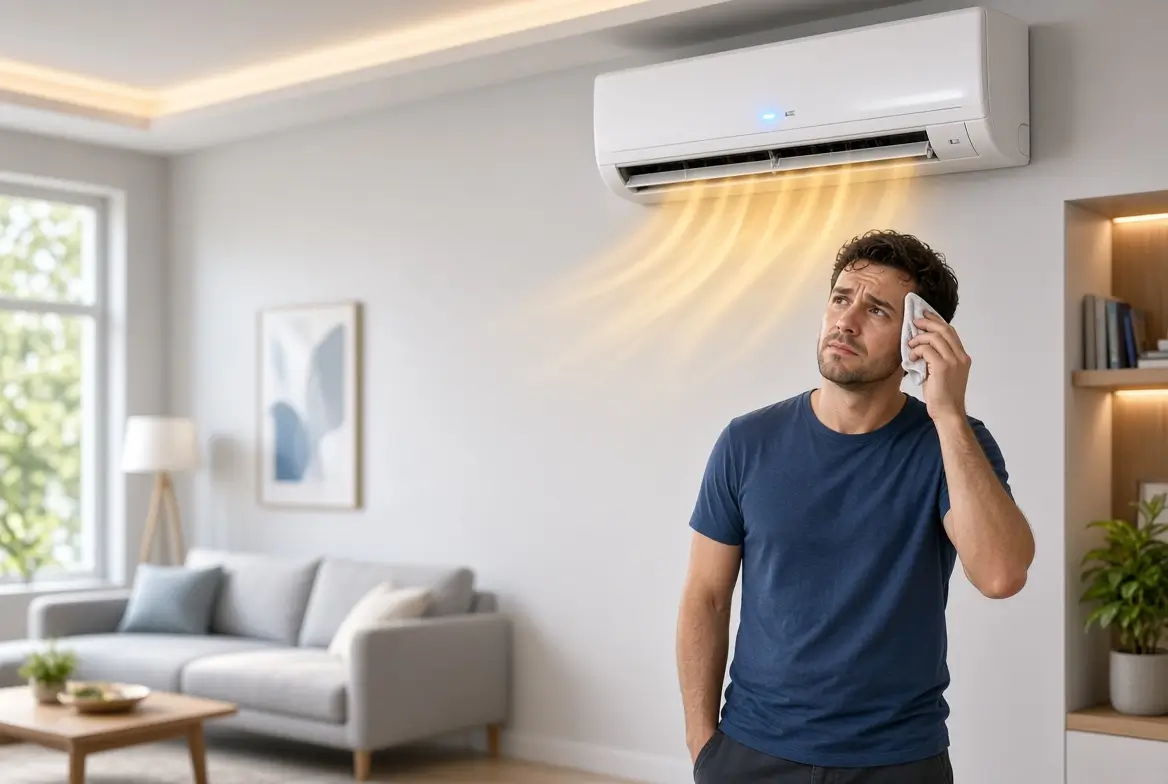
If your air conditioner is running but blowing warm air, the problem could be anything from restricted airflow or a dirty filter to a frozen coil, refrigerant problem, electrical failure, or another HVAC issue.
Call today to discuss your AC problem and find out what may be causing your system to run without properly cooling your home.
Call 313-254-6072When your air conditioner is running but the house isn’t getting cool, it can be frustrating—especially on a hot Michigan afternoon.
You may hear the indoor fan running, feel air coming from the vents, and assume the system is working. But if that air isn’t cold, something isn’t right.
So, why is your AC running but not blowing cold air?
The most common causes include a dirty air filter, restricted airflow, a dirty outdoor condenser, low refrigerant, a frozen evaporator coil, a failing capacitor, or a problem with the compressor or thermostat.
Some problems are simple enough for a homeowner to check. Others require an HVAC professional because refrigerant, electrical components, and the compressor should not be serviced as a DIY project.
Here’s how to figure out what may be happening before you spend money on a repair.
Why Is My AC Running but Not Cooling the House?
If your air conditioner is running continuously but the temperature inside keeps climbing, the system may not be producing enough cooling.
Common causes include:
- A dirty air filter
- Blocked or closed vents
- A dirty outdoor condenser coil
- A frozen evaporator coil
- Low or leaking refrigerant
- A malfunctioning thermostat
- A failed capacitor
- A problem with the compressor
- A failing blower motor
- Poor airflow
- An undersized or aging AC system
The first thing to determine is whether the system is actually producing cold air or simply circulating room-temperature air.
Why Is My AC Blowing Warm Air?
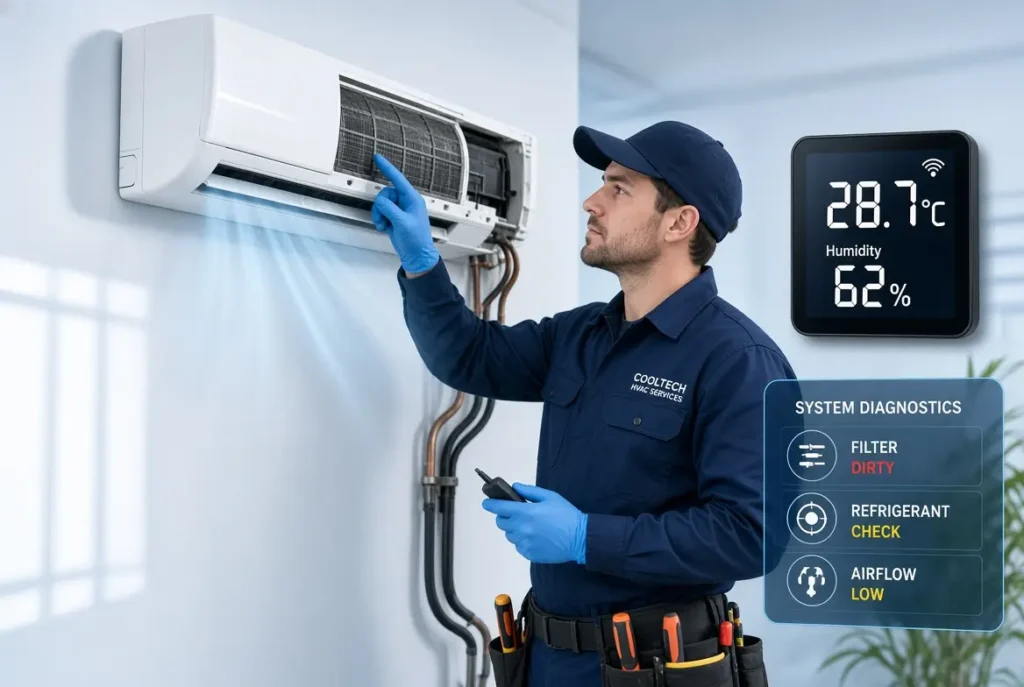
Warm air from the vents can happen for several reasons.
Start with the simple possibilities.
Check whether:
- The thermostat is set to COOL.
- The desired temperature is lower than the current room temperature.
- The indoor fan is running.
- The air filter is clean.
- The outdoor unit is operating.
If the indoor blower is running but the outdoor condenser isn’t, you may have a problem with the outdoor unit, thermostat, electrical system, or controls.
If both units are running but the air isn’t getting cold, refrigerant, airflow, coil, or compressor problems become more likely.
Should My AC Outdoor Unit Be Running?
Normally, yes, when the system is actively calling for cooling.
Your central AC uses the outdoor condenser to release heat that has been removed from inside your home.
If you hear the indoor blower but the outdoor unit is completely silent, that’s an important clue.
Possible causes include:
- Electrical problems
- A tripped breaker
- A failed capacitor
- Thermostat problems
- A contactor problem
- Wiring issues
- Motor failure
- Compressor problems
Check your electrical panel for an obviously tripped breaker, but don’t repeatedly reset a breaker that keeps tripping.
Repeated breaker trips can indicate an electrical or equipment problem that needs professional attention.
What If the Outdoor AC Unit Is Running but the Air Isn’t Cold?
This is a different situation.
If the outdoor condenser is running and the indoor blower is moving air, but the air coming from the vents isn’t cold, the system may have a refrigeration or airflow problem.
Potential causes include:
- Low refrigerant
- A refrigerant leak
- A frozen evaporator coil
- A dirty condenser
- A dirty air filter
- A failing compressor
- Restricted airflow
- A malfunctioning metering component
At this point, changing the thermostat setting repeatedly usually isn’t going to solve the problem.
Can a Dirty Air Filter Cause My AC to Stop Cooling?
Yes.
A severely dirty air filter can restrict airflow through the HVAC system.
That can reduce cooling performance and, in some cases, contribute to the evaporator coil becoming too cold and freezing.
Check your filter if you haven’t changed it recently.
If it’s visibly dirty, replace it with the correct size and type recommended for your system.
Don’t assume that installing the thickest or most restrictive filter available is automatically better. Your HVAC system needs adequate airflow.
How Do I Know If My AC Filter Is Too Dirty?
Remove the filter and inspect it.
If you can barely see the filter material through accumulated dust and debris, it’s probably time for replacement.
A dirty filter can also contribute to:
- Weak airflow
- Higher energy use
- Longer cooling cycles
- Uneven temperatures
- Frozen coils
A filter is one of the easiest things a homeowner can check before calling for service. Changing an AC filter is simple and should be done every 90 days.
Why Is My AC Running Constantly but My House Is Still Hot?
An AC system may run for long periods during extremely hot weather.
But if it’s running constantly and the indoor temperature continues rising, something may be wrong.
Possible causes include:
- Low refrigerant
- Restricted airflow
- Dirty coils
- Poor insulation
- Ductwork problems
- A failing compressor
- An undersized AC
- Extremely high outdoor temperatures
If the system used to cool the house normally but suddenly can’t keep up, a mechanical problem is more likely than simply needing a larger system.
Why Is My AC Not Keeping Up on a Hot Day?
There is a difference between running frequently because it’s hot outside and running continuously while failing to reach the thermostat setting.
During extreme heat, your AC may have difficulty maintaining the exact temperature you want.
But if the system runs for hours and the temperature keeps climbing, check the basics first.
Make sure:
- The filter is clean.
- Supply vents are open.
- Return vents aren’t blocked.
- The outdoor condenser isn’t obstructed.
- The thermostat is working correctly.
If those items are fine, the system may need professional diagnosis.
Why Is My AC Frozen?
A frozen AC coil may seem strange when you’re trying to cool your house during hot weather.
But it happens.
A frozen evaporator coil can be caused by:
- Restricted airflow
- A dirty filter
- A dirty coil
- Low refrigerant
- Mechanical problems
You may notice:
- Ice on the copper refrigerant line
- Ice around the indoor coil
- Water underneath the indoor unit
- Weak airflow
- Warm air coming from the vents
Don’t keep running the AC while the coil is frozen.
Turn the cooling system off and allow the ice to thaw. If the problem returns, the underlying cause needs to be diagnosed.
Can Low Refrigerant Cause My AC to Blow Warm Air?
Yes.
Refrigerant is essential to the cooling process.
If the system has lost refrigerant, it may not be able to remove enough heat from your home.
Signs can include:
- Warm air from vents
- Long cooling cycles
- Ice on refrigerant lines
- Poor cooling performance
- A gradual decline in system performance
However, refrigerant doesn’t normally get “used up.”
If a system is low, there may be a leak or another problem that needs to be identified.
Simply adding refrigerant without addressing the cause isn’t a complete repair.
Does an AC Need Refrigerant Refilled Every Year?
No.
A properly functioning, sealed air-conditioning system should not require routine annual refrigerant additions.
If your AC repeatedly needs refrigerant, that is a reason to investigate for a leak.
Adding refrigerant over and over without finding the underlying problem can become an expensive temporary solution.
Why Is There Ice on My AC Pipe?
Ice on the refrigerant line is a warning sign.
It can happen when the evaporator coil becomes too cold.
Possible causes include:
- Low refrigerant
- Restricted airflow
- Dirty filters
- Dirty coils
- Mechanical problems
Turn the cooling system off and allow it to thaw rather than continuing to run it while covered in ice.
If the ice returns after the system is restarted, have the system inspected.
Can a Dirty Outdoor AC Unit Cause Warm Air?
Yes.
The outdoor condenser needs to release the heat removed from inside your house.
If the condenser coil is heavily covered with dirt, grass clippings, leaves, or other debris, heat transfer can become less effective.
Before cleaning it, turn off power to the equipment and follow the manufacturer’s recommendations.
Don’t bend the delicate condenser fins or use excessive water pressure.
Also make sure grass, shrubs, fencing, and other objects aren’t restricting airflow around the condenser.
How Much Space Should Be Around an Outdoor AC Unit?
Your condenser needs adequate airflow.
Don’t crowd it with:
- Tall grass
- Shrubs
- Stored items
- Outdoor furniture
- Fencing
- Yard equipment
The exact clearance requirements depend on the equipment and manufacturer, so follow the installation and maintenance recommendations for your specific unit.
Why Is My AC Making a Humming Noise but Not Cooling?
A humming outdoor unit that isn’t operating normally can indicate an electrical or motor-related problem.
Possible causes include:
- A failing capacitor
- Motor problems
- Contactor problems
- Compressor issues
- Electrical faults
Don’t open the electrical compartment or attempt to replace electrical components unless you’re qualified to do so.
A capacitor can retain an electrical charge even after power is disconnected.
Why Does My AC Click but Not Turn On?
A clicking sound may come from the thermostat or outdoor equipment.
If the system repeatedly clicks without starting, possible problems include:
- Thermostat issues
- Contactor problems
- Electrical problems
- Capacitor failure
- Compressor problems
If the system isn’t starting normally, it’s better to have the cause diagnosed rather than repeatedly cycling the thermostat.
Why Is My AC Blowing Weak Air?
Weak airflow can make the AC feel like it isn’t cooling even when the refrigeration system is working.
Possible causes include:
- Dirty filter
- Blocked return vent
- Closed supply registers
- Dirty evaporator coil
- Blower motor problems
- Ductwork problems
- Frozen coil
Start with the filter and vents.
If airflow remains weak, the HVAC system may need a professional inspection.
Why Is One Room Hotter Than the Rest of the House?
If only one or two rooms are hot, the entire AC system may not be failing.
The problem could involve:
- Closed or restricted vents
- Ductwork leaks
- Poor insulation
- Poor airflow
- Room location
- Windows receiving significant sunlight
- An improperly balanced HVAC system
If the whole house is warm, mechanical cooling problems become more likely.
If only one room is consistently uncomfortable, investigate airflow and ductwork as well.
Why Is My AC Cold Upstairs but Warm Downstairs?
Or the opposite.
Temperature differences between floors are common because heat naturally moves upward and homes can have uneven ductwork and airflow.
Possible contributors include:
- Duct design
- Insulation
- Air leaks
- Thermostat location
- Zoning
- Closed vents
- Ductwork restrictions
If the temperature difference suddenly appeared, however, don’t assume it’s just a design issue.
A new change can indicate an HVAC problem.
Can a Bad Thermostat Cause My AC Not to Cool?
Yes.
A thermostat controls when your HVAC system calls for cooling.
Problems can occur because of:
- Incorrect settings
- Weak batteries
- Wiring problems
- Sensor problems
- Thermostat failure
- Communication problems on certain systems
Before calling for service, verify the thermostat is actually set to cooling and that the set temperature is below the current indoor temperature.
Why Does My AC Work at Night but Not During the Day?
If your AC seems to work better at night, extreme daytime heat may be exposing an underlying problem.
During the hottest part of the day, the system has to remove more heat.
A marginal system may appear adequate in the evening but struggle during peak afternoon temperatures.
Potential causes include:
- Low refrigerant
- Dirty condenser
- Poor airflow
- Weak compressor performance
- Insufficient insulation
- Excessive heat gain
If this happens every summer, an HVAC professional can determine whether you’re dealing with equipment limitations or a correctable problem.
Why Does My AC Stop Cooling After Running for a While?
An AC that starts cold and then begins blowing warm air may have a problem that develops as the system operates.
Possible causes include:
- A frozen coil
- Overheating equipment
- Electrical component failure
- Compressor problems
- Refrigerant issues
- Restricted airflow
Pay attention to what happens immediately before the cooling stops.
Does the outdoor unit shut off?
Does the indoor fan keep running?
Does ice appear?
Does the system restart after sitting for a while?
Those clues can help a technician diagnose the problem.
What Should I Check Before Calling an HVAC Technician?
You can safely check several basic things.
1. Check the Thermostat
Make sure it’s set to COOL and the temperature setting is below the current indoor temperature.
2. Check the Air Filter
Replace a dirty filter with the correct replacement.
3. Check the Vents
Make sure supply vents are open and return vents aren’t blocked.
4. Check the Outdoor Unit
Make sure it’s not buried in grass, leaves, or other debris.
5. Check the Electrical Panel
Look for an obviously tripped breaker.
Don’t repeatedly reset a breaker that trips again.
6. Look for Ice
Check the accessible refrigerant line for obvious ice buildup.
If the system is frozen, turn off cooling and allow it to thaw.
If those basic checks don’t solve the problem, it’s time for professional diagnosis.
Should I Turn My AC Off If It Is Blowing Warm Air?
If the system is clearly malfunctioning, continuing to run it may not help.
This is particularly true if:
- The coil is frozen.
- The outdoor unit isn’t operating correctly.
- The system is making unusual noises.
- A breaker keeps tripping.
- There is water around electrical equipment.
- The compressor is behaving abnormally.
Turn the system off and arrange for an inspection rather than repeatedly restarting it.
Can I Add Refrigerant to My AC Myself?
Refrigerant service isn’t a typical DIY repair.
Handling refrigerants requires appropriate equipment, procedures, and in many cases EPA certification requirements apply.
More importantly, if the system is low, simply adding refrigerant doesn’t answer the important question:
Why did the refrigerant level become low?
A leak or equipment problem may need to be identified and repaired.
How Long Should an AC Take to Cool a House?
There isn’t one universal answer.
Cooling time depends on:
- Outdoor temperature
- Indoor temperature
- House size
- Insulation
- Windows
- AC capacity
- Ductwork
- Humidity
- Condition of the equipment
An air conditioner doesn’t necessarily need to drop the temperature dramatically in a few minutes.
The important question is whether the system is steadily moving the indoor temperature toward the thermostat setting.
If it runs continuously without making meaningful progress, something may be wrong.
Is My AC Too Old to Repair?
Age alone doesn’t automatically mean replacement is the best option.
Consider:
- The age of the equipment
- Repair cost
- Previous repairs
- Energy efficiency
- Availability of parts
- Overall system condition
- Expected remaining service life
A relatively inexpensive repair may make sense for an older but otherwise reliable system.
A major compressor repair on an aging system may be a different calculation.
Ask for both the repair recommendation and the expected condition of the system afterward.
When Should I Call an HVAC Professional?
Call for professional help when:
- The AC runs but doesn’t cool.
- The outdoor unit isn’t operating.
- The system repeatedly freezes.
- Refrigerant appears to be low.
- Ice keeps returning.
- The compressor won’t start.
- A breaker repeatedly trips.
- The system makes unusual electrical noises.
- Airflow remains weak after changing the filter.
- The problem keeps returning.
- The system requires refrigerant service.
If electrical components or refrigerant are involved, DIY troubleshooting should stop at basic observation and maintenance.
Frequently Asked Questions About an AC That Isn’t Blowing Cold Air
Why is my AC running but not blowing cold air?
Common causes include a dirty filter, frozen evaporator coil, low refrigerant, dirty condenser, airflow restriction, thermostat problem, or failing mechanical component.
Why is my AC blowing warm air all of a sudden?
A sudden change can indicate a mechanical or electrical problem, such as a failed capacitor, compressor issue, refrigerant problem, frozen coil, or outdoor unit failure.
Why is my outside AC unit running but not cooling?
The outdoor unit may be operating while the system has a refrigerant, airflow, coil, or compressor problem. A professional diagnosis may be needed.
Why is my inside AC fan running but the outside unit isn’t?
Possible causes include a tripped breaker, thermostat issue, capacitor failure, contactor problem, wiring problem, or outdoor equipment failure.
Can a dirty filter make my AC blow warm air?
Yes. Severe airflow restriction can reduce cooling performance and may contribute to a frozen evaporator coil.
Why is there ice on my AC?
Ice can result from restricted airflow, low refrigerant, a dirty coil, or another mechanical problem. Turn off cooling and allow the system to thaw rather than continuing to run it frozen.
Should I keep running my AC if it’s frozen?
No. Continuing to operate a frozen system can worsen the problem. Allow it to thaw and have the cause investigated if the freezing returns.
Does low refrigerant mean my AC needs more refrigerant?
It may, but the reason for the low refrigerant should also be investigated. Repeatedly adding refrigerant without addressing a leak isn’t a permanent solution.
Why does my AC work at night but not during the day?
Higher daytime temperatures put more demand on the system. An underlying cooling or airflow problem may become more obvious during the hottest part of the day.
Can a bad thermostat cause my AC to stop cooling?
Yes. A faulty thermostat may fail to properly communicate the demand for cooling.
Why is my AC running constantly?
Long cycles can occur during extreme heat, but constant operation with a rising indoor temperature can indicate a cooling, airflow, ductwork, or equipment problem.
How do I fix an AC that runs but doesn’t cool?
Start by checking the thermostat, air filter, vents, outdoor condenser, and electrical panel. If those aren’t the problem, professional diagnosis may be needed.
The Truth of Why Your AC isn’t Cold
If your AC is running but your house isn’t getting cool, don’t automatically assume it needs more refrigerant or a new air conditioner.
Start with the simple things.
Check the thermostat. Replace a dirty filter. Make sure vents are open. Inspect the outdoor unit for obvious debris and check whether it’s actually operating.
If you find ice, turn the cooling system off and allow it to thaw.
If the problem continues, the cause could be low refrigerant, a refrigerant leak, electrical failure, a dirty coil, restricted airflow, compressor trouble, or another mechanical problem.
The important thing is to diagnose the reason your AC isn’t cooling instead of repeatedly restarting it or guessing at the repair.
A small problem caught early can sometimes be much less expensive than a neglected AC problem that turns into equipment damage.