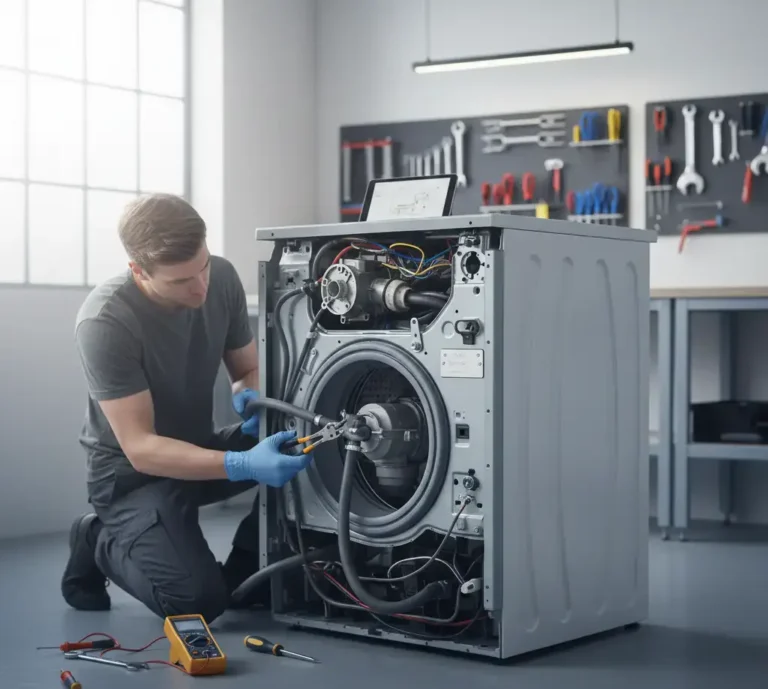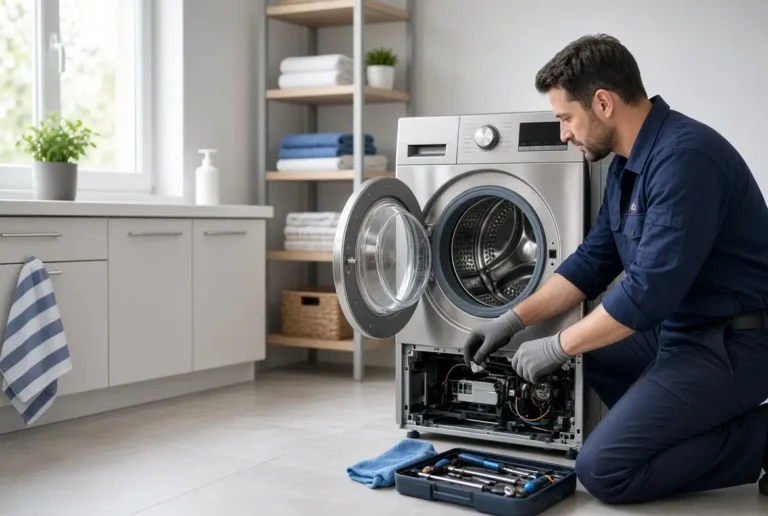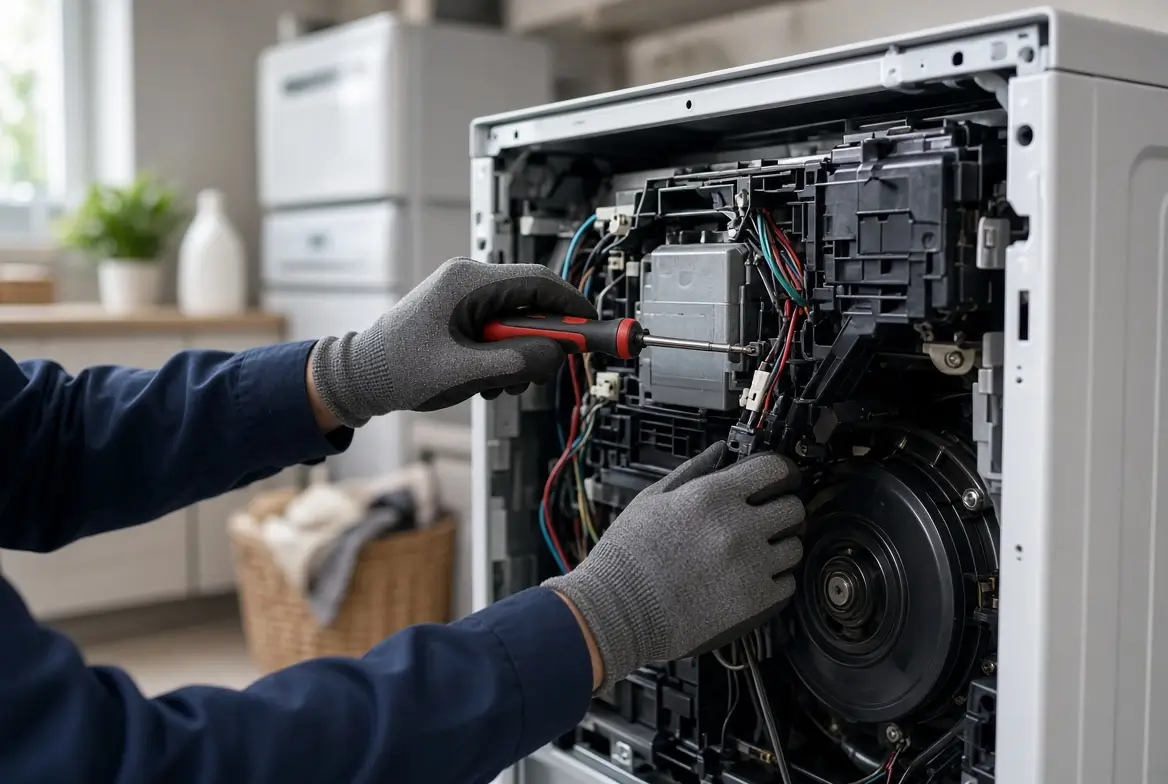
DIY Troubleshooting Before Calling a Handyman: 5 Common Washer Problems Solved
Need Help With a Washing Machine Problem?
If your washer is leaking, making unusual noises, refusing to drain, or giving you trouble, professional troubleshooting can help identify the problem and determine the next step.
Call 313-362-6383 TodayA washing machine that leaks, refuses to drain, makes strange noises, or suddenly displays an error code does not always need a major repair.
Sometimes the solution is as simple as clearing a clogged hose, leveling the machine, redistributing a load, or checking a basic connection.
Before searching for a handyman for washing machine problems, there are several safe troubleshooting steps you can try yourself.
The key is knowing where DIY troubleshooting ends and professional repair begins.
Here are five of the most common washing-machine problems homeowners encounter, what you can check yourself, and when it makes sense to call a handyman.
1. Why Is My Washing Machine Leaking?
A leaking washer can have several causes, and the location of the water can provide an important clue.
The first step is to stop the washing machine and determine where the water is coming from.
Step 1: Stop the Washer
If water is actively leaking, stop the cycle.
If there is a significant amount of water on the floor, unplug the washer if you can do so safely without standing in water.
Do not reach behind or underneath an appliance while standing in pooled water.
Step 2: Check the Water Supply Hoses
Look behind the washing machine for the hot and cold water supply hoses.
Check for:
- Loose connections
- Cracked hoses
- Bulging sections
- Drips around the fittings
- Water spraying from a connection
A loose connection may sometimes be tightened by hand.
If a hose is cracked, damaged, or bulging, replacement is usually a better solution than trying to patch it.
Step 3: Check the Drain Hose
The drain hose carries used water from the washer into the home’s drain system.
Make sure it has not:
- Come loose
- Become kinked
- Fallen out of the drain opening
- Developed a crack
- Become blocked
A drain hose that has slipped out of position can cause water to spill onto the floor during the drain cycle.
Step 4: Look Around the Door or Lid
Front-loading washers can leak around the door if the rubber door seal is dirty, damaged, or obstructed.
Check the seal for:
- Hair
- Dirt
- Small objects
- Tears
- Cracks
- Excessive buildup
For a top-loading washer, check that the lid closes properly and that water is not being thrown out during an overloaded or unbalanced cycle.
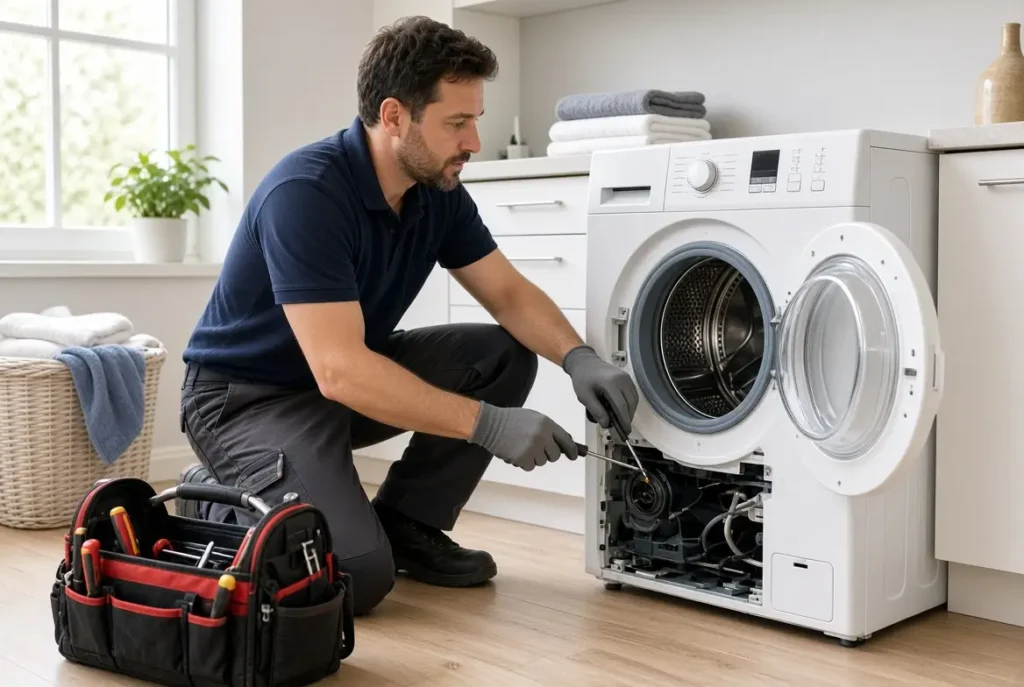
When Should You Call a Handyman?
If the washer is leaking from underneath the cabinet, continues leaking after the hoses are checked, or appears to have an internal component failure, DIY troubleshooting may no longer be enough.
A professional can inspect the machine and determine whether the problem is a hose, pump, seal, valve, or another component.
2. Why Is My Washing Machine Making a Loud Noise?
A washer can make some noise during normal operation. Spinning, agitating, filling, and draining all produce different sounds. But a sudden banging, grinding, scraping, or unusually loud vibration deserves attention.
Step 1: Stop and Redistribute the Load
An unbalanced load is one of the most common reasons a washer starts banging during the spin cycle.
Large items such as blankets, towels, and rugs can become concentrated on one side of the drum.
Stop the machine and redistribute the clothes evenly. Then restart the spin cycle. If the noise disappears, the machine may simply have been dealing with an unbalanced load.
Step 2: Check Whether the Washer Is Level
A washing machine that rocks back and forth can become extremely noisy during high-speed spinning.
Place your hands on the top of the washer and gently push it from different directions.
If it rocks, the machine may not be level. Adjustable leveling feet can often correct the problem.
Step 3: Check for Objects
Coins, buttons, zippers, bra wires, and other objects can sometimes become trapped inside or around the drum.
If you hear a repeated rattling or scraping sound, stop the machine and inspect what you can safely access.
Do not disassemble the washer simply to retrieve an object unless you know exactly what you are doing.
Step 4: Listen to When the Noise Happens
Timing can help identify the problem.
A noise during:
- Spin: could indicate an unbalanced load, leveling problem, bearing issue, or suspension problem.
- Agitation: could indicate an object, agitator problem, or mechanical issue.
- Drain: could indicate a pump obstruction or failing drain pump.
- Filling: could point toward a water valve or supply problem.
When Is the Noise a Professional Problem?
A washer that continues making grinding, roaring, scraping, or mechanical noises after being leveled and properly loaded may have an internal problem.
That is a good point to stop troubleshooting and call a professional.
3. What Should I Do If My Washer Displays an Error Code?
Error codes can look intimidating, but they are often the washing machine’s way of telling you where to start troubleshooting.
The exact meaning depends on the manufacturer and model.
Step 1: Write Down the Code
Before turning the machine off, record the exact error code.
Take a picture if necessary.
Something like “E3” or “F21” can mean completely different things on different washer models.
Step 2: Check the Owner’s Manual
Look up the code in your owner’s manual.
If you do not have the manual, use the manufacturer’s model number to find the correct documentation.
Do not assume that an error code means a particular part has failed simply because an online article says so.
Step 3: Try a Basic Reset
Some temporary electronic faults can clear after the machine is powered down.
Turn the washer off and disconnect power according to the manufacturer’s instructions.
Wait several minutes before restoring power and testing the machine again.
If the error disappears and the washer works normally, monitor it.
If the same code immediately returns, the problem likely needs further investigation.
Step 4: Look for the Problem the Code Describes
Some codes relate to conditions homeowners can check themselves.
For example, a drain-related code may lead you to inspect the drain hose or accessible filter.
A door-lock code may lead you to check whether the door is properly closed and whether something is preventing the latch from engaging.
When Should You Stop?
If an error code continues appearing after the basic troubleshooting steps, do not keep resetting the machine over and over.
Repeated error codes often indicate an underlying problem.
A professional can diagnose the cause instead of simply clearing the symptom.
4. Why Won’t My Washing Machine Drain?
A washer that finishes the wash cycle but leaves clothes sitting in dirty water has a drainage problem.
Fortunately, this is one of the situations where a basic homeowner check can sometimes solve the problem.
Step 1: Stop the Machine
Turn the washer off.
If there is standing water inside the drum, follow your manufacturer’s instructions for safely removing it.
Do not force open a locked front-loading washer door.
Step 2: Check the Drain Hose
Look at the drain hose behind the machine.
Make sure it is not:
- Kinked
- Crushed
- Blocked
- Disconnected
- Inserted incorrectly into the drain
A restricted drain hose can prevent the washer from removing water properly.
Step 3: Check the Drain
The problem may not actually be the washing machine.
If the home’s drain is clogged, water may not leave the washer quickly enough.
Look for signs that another nearby fixture is also draining slowly.
For example, if a utility sink, floor drain, or nearby plumbing fixture is backing up, the washer may be encountering a larger drainage problem.
Step 4: Check the Accessible Filter
Some washing machines have a drain pump filter that homeowners can access. The location varies by model.
If your owner’s manual provides instructions for cleaning it, follow those instructions carefully. Be prepared for water to come out when the filter is opened.
Step 5: Test the Washer
After clearing an obvious obstruction, run an appropriate drain or rinse cycle.
If the washer drains normally, the problem may have been a simple blockage.
If it continues to leave water in the drum, there may be a problem with the pump, wiring, control system, or another internal component.
When Should a Professional Handle It?
Call a professional if the pump is making unusual noises, the washer repeatedly fails to drain, there is an electrical issue, or the blockage cannot be safely accessed.
5. Why Won’t My Washing Machine Start?
Sometimes the problem is not inside the washer at all. Before assuming the appliance has failed, check the basics.
Step 1: Check the Power
Make sure the washer is plugged in securely. Check the circuit breaker if the machine has no power.
If the breaker trips again after being reset, do not repeatedly reset it. A recurring breaker trip can indicate an electrical problem that needs professional attention.
Step 2: Check the Door or Lid
Many modern washing machines will not start unless the door or lid is properly closed and locked.
Check for clothing or objects preventing the door from closing completely.
Step 3: Check the Controls
Make sure a cycle has actually been selected.
Some washers require you to press and hold the Start button for several seconds.
Others will not begin until the door locks.
Step 4: Look for an Error Code
If the display shows an error code, record it before resetting the washer.
The code may provide a clue about why the machine will not start.
Step 5: Try a Basic Power Reset
If the manufacturer recommends it, disconnect power and wait several minutes before restoring power.
If the washer remains completely unresponsive, there may be an electrical, control-board, door-lock, or other internal problem.
What Washing Machine Problems Can You Fix Yourself?
Some washer problems are reasonable for a homeowner to troubleshoot.
These include:
- An unbalanced load
- A washer that is not level
- A kinked drain hose
- A loose water hose connection
- A dirty accessible filter
- An improperly closed door
- A simple temporary error
- A tripped breaker when there is no sign of an electrical problem
The common theme is that these checks do not require you to dismantle the appliance.
What Washing Machine Problems Need a Professional?
A professional should be considered when the problem involves components that require disassembly, electrical diagnosis, specialized tools, or appliance-specific knowledge.
Examples include:
- Internal water leaks
- Failed drain pumps
- Broken door-lock mechanisms
- Motor problems
- Bearing failures
- Electrical faults
- Wiring problems
- Repeated circuit-breaker trips
- Control-board problems
- Persistent error codes
- Mechanical grinding or scraping
A handyman may be appropriate for some appliance-related troubleshooting and surrounding home repairs, while certain appliance failures may require an appliance repair technician.
The important thing is getting the right professional for the actual problem.
How Do I Know If My Washer Is Worth Repairing?
Consider the age and condition of the washer.
A relatively new machine with a simple problem may be worth repairing.
An older washer with multiple symptoms may make replacement more practical.
Also consider the repair cost compared with the price of a replacement machine.
If a professional identifies a major component failure, ask for the repair cost before approving the work.
You can then make an informed repair-versus-replace decision.
What Should I Do Before Calling a Handyman for a Washing Machine Problem?
Before making the call, gather a few pieces of information.
Write down:
- Washer manufacturer
- Model number
- Approximate age
- Exact problem
- Error code, if displayed
- When the problem occurs
- Whether the washer leaks
- Whether it drains
- Whether it makes unusual noises
- Whether the problem happens every cycle
A short video of the noise or problem can also be useful.
The more information you can provide, the easier it may be for the professional to determine what needs to be checked.
Call-the-Handyman Decision Flowchart
Use this simple decision process before deciding what to do next:
Washer leaking?
→ No: Continue troubleshooting.
→ Yes: Check the supply hoses, drain hose, door/lid area, and visible connections.
→ Leak continues or comes from inside/under the machine?
Call a professional.
Washer making noise?
→ Redistribute the load and check whether the washer is level.
→ Noise disappears?
Resume normal use and monitor it.
→ Grinding, scraping, roaring, or repeated banging continues?
Call a professional.
Washer showing an error code?
→ Record the code and check the manufacturer’s instructions.
→ Simple issue identified and resolved?
Test the washer.
→ Code returns?
Call a professional.
Washer won’t drain?
→ Check the drain hose and accessible filter according to the manufacturer’s instructions.
→ Drains normally afterward?
Problem solved.
→ Still won’t drain?
Call a professional.
Washer won’t start?
→ Check power, breaker, door/lid, controls, and error codes.
→ Still completely unresponsive?
Call a professional.
Know When Your Washer Needs A Repair Call
Not every washing-machine problem requires a repair call.
A clogged hose, unbalanced load, dirty filter, loose connection, or leveling problem may be something you can identify yourself.
But once troubleshooting moves into electrical components, internal pumps, motors, bearings, wiring, control boards, or hidden leaks, it is usually time to stop guessing.
If you need a handyman for washing machine troubleshooting or related home repairs, getting the problem properly evaluated can save you from replacing parts unnecessarily or making the problem worse.
Frequently Asked Questions
Can a handyman fix a washing machine?
A handyman may be able to help with certain appliance-related problems, installation issues, hoses, connections, surrounding plumbing, or general troubleshooting. More specialized appliance failures may require an appliance repair technician.
Why is my washing machine leaking from the bottom?
A leak from underneath the washer can be caused by an internal hose, pump, seal, or other component. If checking the external hoses does not identify the source, professional diagnosis is recommended.
Why is my washer making a loud banging noise?
The most common simple causes are an unbalanced load or a washer that is not level. Redistribute the clothes and check the machine’s leveling before assuming there is an internal mechanical problem.
Why does my washing machine stop with water inside?
A clogged drain hose, blocked filter, drain pump problem, or household drain issue can prevent the washer from draining properly.
Should I keep resetting my washing machine when an error code appears?
No. A reset may clear a temporary problem, but repeatedly resetting the washer without finding the cause can leave the underlying issue unresolved. If the code keeps returning, troubleshoot according to the manufacturer’s instructions or call a professional.
When should I stop troubleshooting my washing machine?
Stop when the problem involves electrical components, internal parts, persistent leaks, repeated error codes, mechanical grinding, or anything you cannot safely access. That is where professional diagnosis becomes worthwhile.