How to Unclog a Shower Drain in Detroit – What The Pros Would Do
Need Help With a Clogged Shower Drain?
If your Detroit shower drain is still clogged after removing hair, plunging, and trying a drain snake, professional drain cleaning can help find and clear stubborn blockages deeper in the line.
Call 313-351-8635 TodayA slow or completely clogged shower drain in Detroit is usually caused by hair, soap residue, and buildup inside the drainpipe. In most cases, Detroit homeowners can clear a typical shower clog themselves without harsh chemical drain cleaners.
The easiest approach is to start with the simplest method: remove visible hair, flush the drain with hot water, use a plunger if necessary, and then use a small drain snake or drain-cleaning tool to pull out deeper buildup.
For homeowners in Detroit, Hamtramck, Dearborn, Highland Park, Livonia, Warren, and surrounding Metro Detroit communities, regular drain maintenance can help prevent a minor shower clog from turning into a larger drain-cleaning problem.
If the DIY methods don’t work, a professional Detroit drain cleaning service can inspect the line and determine whether the blockage is deeper than the shower drain itself.
What is the easiest way to unclog a shower drain?
Start by removing the drain cover and pulling out whatever hair and debris you can reach.
Then try these steps in order:
- Remove visible hair and debris.
- Flush the drain with hot water.
- Use a plunger.
- Use a plastic drain-cleaning tool or small drain snake.
- Flush the drain again.
- Clean the drain cover before reinstalling it.
If the water starts draining normally after one of these steps, you may have solved the problem without calling a plumber or drain-cleaning company.
If the water remains standing after these steps, the clog may be farther down the drain line.
Why does my Detroit shower drain keep clogging?
The most common cause is hair.
Every shower washes away small amounts of hair. That hair can catch on soap residue and other material inside the drainpipe.
Over time, the mass becomes large enough to slow the water.
Other common causes include:
- Soap scum
- Shampoo residue
- Conditioner buildup
- Dirt and body oils
- Mineral deposits
- Hard-water scale
- A partially blocked drain trap
- A deeper obstruction in the branch drain
Older homes throughout Detroit and surrounding Metro Detroit communities can also have aging plumbing, previous repairs, or drain configurations that make recurring clogs more likely.
A shower that drains slowly for weeks before completely stopping is often giving you a warning that buildup is accumulating.
Step 1: Remove the shower drain cover
Before reaching for chemicals or tools, remove the drain cover.
Depending on the drain, the cover may be held in place by one or more screws or may lift out.
Put the screws somewhere safe so they don’t disappear down the drain.
Once the cover is removed, use a flashlight to look inside.
You may immediately see a ball of hair sitting near the opening.
If you can reach it safely, pull it out using gloves, needle-nose pliers, or a small drain-cleaning tool.
Don’t push the hair farther down the pipe.
The goal is to remove the blockage, not relocate it.
Step 2: Try hot water
If you’ve removed the obvious hair, hot water can help loosen soap and oily buildup.
Slowly pour hot water down the drain.
Don’t use boiling water if your plumbing system or drain components could be damaged by extremely high temperatures.
Very hot tap water is usually sufficient for this first attempt.
Wait a few minutes and see whether the water drains faster.
If it doesn’t, move on to mechanical methods.
Step 3: Use a plunger
A small cup-style plunger can work surprisingly well on a shower drain.
Add enough water to the shower floor to cover the bottom of the plunger.
Position the plunger directly over the drain.
Push down firmly and then pull upward.
Repeat the motion several times.
The goal is to create pressure changes inside the drain that can loosen the obstruction.
If your shower has an overflow opening or another drain opening that allows air into the system, temporarily blocking that opening can help improve plunging pressure.
After several plunging attempts, remove the plunger and see whether the water drains.
Can a plunger unclog a shower drain?
Yes.
A plunger can clear relatively shallow clogs caused by hair, soap residue, and other buildup.
It is worth trying before using a drain snake because it is inexpensive, chemical-free, and relatively low risk.
However, plunging may not solve a clog that is tightly packed deeper inside the pipe.
That’s when a drain snake becomes more useful.
Step 4: Use a plastic drain-cleaning tool
Before using a full drain snake, try a small plastic barbed drain-cleaning tool.
These inexpensive tools are designed to grab hair.
Insert the tool slowly into the drain.
Don’t force it.
When you feel resistance, gently rotate or move the tool around the obstruction.
Then pull it back out.
You may be surprised by how much hair comes out.
Clean the tool and repeat the process until you’re no longer pulling out significant debris.
This is one of the simplest ways to deal with a typical shower clog.
Step 5: Use a drain snake for a stubborn clog
If the plastic tool doesn’t solve the problem, a small hand-operated drain snake may reach farther into the pipe.
Feed the cable slowly into the drain.
When you feel resistance, you’ve likely reached the blockage.
Don’t immediately start forcing the cable.
Instead, rotate the handle while gently pushing the snake forward.
This allows the cable to work into the obstruction.
Once you feel the snake grab something, rotate it several times and slowly pull it back.
The objective is to break up or retrieve the clog, not drive it farther down the plumbing.
If the snake won’t move or becomes stuck, stop rather than forcing it.
A damaged drain connection can turn a simple clog into a much more expensive plumbing repair.
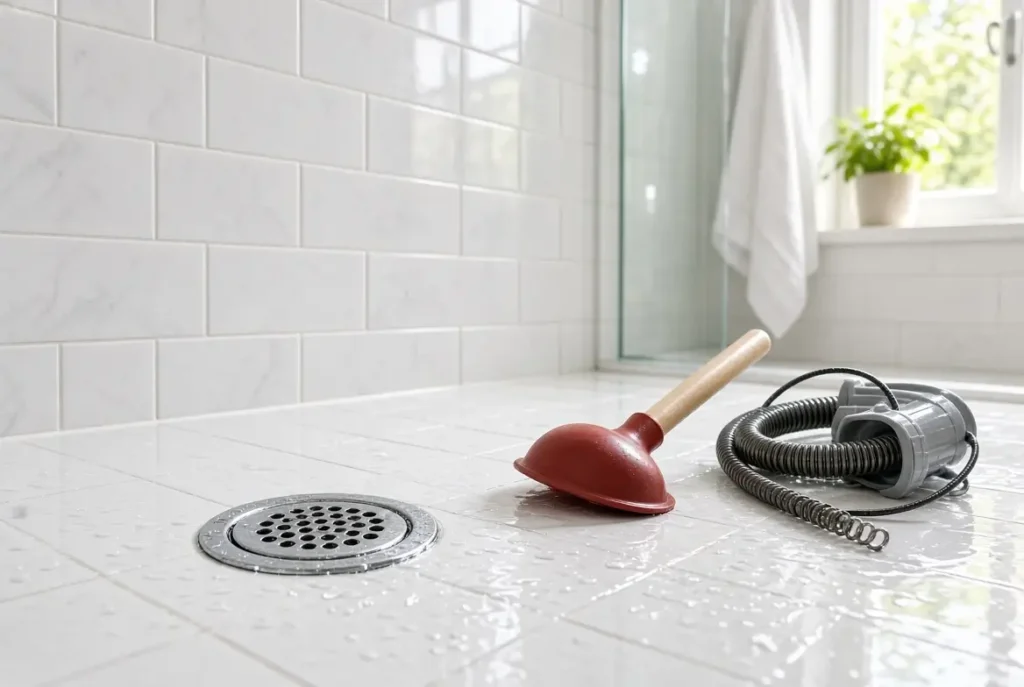
How far should you snake a shower drain?
For a basic shower clog, you generally don’t need to force a small hand snake extremely far into the plumbing.
Start slowly and work through the first section of pipe.
If you encounter significant resistance, don’t aggressively force the cable.
You can damage a drain connection or get the snake stuck.
If the snake repeatedly hits an obstruction that you cannot clear, the problem may be deeper than a typical shower-hair clog.
That’s a good point to consider professional shower drain cleaning in Detroit rather than continuing to force the blockage deeper into the plumbing.
Step 6: Flush the drain again
After removing the blockage, flush the drain with hot water.
Watch how quickly the water disappears.
A properly cleared shower drain should begin draining steadily without water pooling around your feet.
If the drain is still slow, repeat the mechanical cleaning process.
Sometimes a clog consists of multiple layers of hair and soap residue rather than one solid blockage.
Should you use chemical drain cleaner on a shower clog?
Chemical drain cleaners aren’t always the best first choice for a shower clog.
Hair clogs are often easier to remove mechanically.
A chemical product may partially dissolve some buildup while leaving a large amount of hair behind.
There is also an important safety issue.
If you pour chemical drain cleaner into a clogged drain and later decide to use a drain snake, the chemical may still be sitting inside the pipe.
That creates a potential exposure hazard.
For a typical shower clog, removing the physical blockage is usually the better first approach.
What if the shower drain is still clogged after snaking?
If you’ve removed visible hair, plunged the drain, and used a small snake but the shower is still backing up, the obstruction may be farther down the plumbing system.
Possible causes include:
- A deeper branch-line clog
- Significant mineral buildup
- A damaged pipe
- A partially collapsed pipe
- A problem farther downstream
- Multiple fixtures draining slowly because of a larger blockage
This is where professional drain cleaning can make more sense than continuing to work from the shower opening.
A professional drain-cleaning technician can use longer equipment to reach deeper into the line and determine whether the blockage is isolated to the shower or connected to a larger drainage problem.
Why is my shower drain slow but not completely clogged?
A partially blocked drain often produces exactly this symptom.
Water can still squeeze through the remaining opening, but the flow is restricted.
Hair and soap buildup commonly cause this type of slow drain.
Don’t ignore it.
A slow drain is often easier to fix than a completely blocked drain.
Cleaning it early can prevent the situation from becoming a shower full of standing water.
If you’re in Detroit and notice the shower getting slower every week, don’t wait until the drain stops completely before addressing it.
Does Detroit’s hard water cause shower drain clogs?
Hard water can contribute to buildup.
Minerals can accumulate on plumbing surfaces and combine with soap residue, hair, and other debris.
That doesn’t mean hard water is necessarily the sole cause of a clogged shower drain.
In most household showers, hair remains one of the biggest contributors.
But mineral and soap buildup can make an existing hair clog more stubborn.
That’s one reason regular drain cleaning and prevention can be worthwhile for Detroit-area homeowners.
How can you prevent hair from clogging your shower drain?
The easiest prevention method is a shower drain hair catcher.
A properly sized catcher sits over or inside the drain and catches hair before it enters the plumbing.
Clean it regularly.
Depending on how much hair your household produces, that could mean cleaning it every few showers or at least once a week.
You should also occasionally remove the drain cover and inspect underneath it.
Catching the buildup early is much easier than dealing with a completely blocked drain.
Can you prevent soap buildup in a shower drain?
You can reduce it, although you can’t eliminate it completely.
Keep the shower clean and remove accumulated hair regularly.
Rinsing the shower area thoroughly after cleaning can also help remove loose soap residue.
If your home has significant mineral buildup, periodic mechanical drain cleaning can help keep the pipe from becoming heavily restricted.
The key is consistency.
Five minutes of maintenance is easier than dealing with a completely backed-up shower.
When should you stop trying to unclog the shower yourself?
DIY drain cleaning makes sense when you’re dealing with a straightforward shower clog.
It’s time to consider professional help if:
- The drain remains blocked after mechanical cleaning.
- The clog returns very quickly.
- Multiple drains are backing up.
- The toilet bubbles when the shower drains.
- You hear gurgling from other drains.
- Water backs up into another fixture.
- You suspect a deeper sewer-line problem.
- A drain snake becomes stuck.
- You have already used chemical drain cleaner and need additional mechanical work.
These symptoms can indicate that the problem isn’t just hair sitting underneath the shower drain.
For homeowners searching for drain cleaning in Detroit, these are the situations where professional equipment can be more useful than another round of DIY plunging.
Why does my shower drain clog again after I clean it?
If a shower repeatedly clogs, there may be an ongoing source of buildup.
The most common explanation is that some of the original blockage remains inside the pipe.
Another possibility is that the drain has a section where hair and soap repeatedly collect.
If the clog returns every few weeks despite thorough cleaning, don’t simply keep treating the symptom.
A professional may need to inspect the drain farther down the line.
Recurring shower clogs can sometimes indicate a larger drainage issue rather than simply another ball of hair.
What if several drains in my Detroit home are slow?
This is an important distinction.
If only the shower is slow, the blockage may be isolated to that fixture.
If the shower, bathroom sink, bathtub, kitchen sink, or toilet are all showing drainage problems, you may have a larger obstruction in a shared drain line.
Watch for:
- Multiple slow drains
- Toilets bubbling
- Water backing up into tubs
- Gurgling sounds
- Sewer odors
- Wastewater coming back through another fixture
When several fixtures are affected, stop treating it like a simple shower clog.
A Detroit drain cleaning professional may need to inspect the larger drain system.
When is professional drain cleaning worth it?
Professional drain cleaning becomes worthwhile when the clog is too deep, keeps returning, or affects multiple fixtures.
A professional can use equipment designed to reach farther into the plumbing than a typical homeowner’s hand snake.
This is especially useful when:
- The clog is beyond the trap.
- A hand snake won’t clear it.
- The blockage keeps returning.
- Multiple fixtures are affected.
- You suspect heavy buildup.
- The drain has been problematic for years.
- You need to determine whether the problem is a drain clog or a larger sewer-line issue.
The goal isn’t simply to get the water moving again.
The goal is to determine why the drain keeps backing up and address the actual obstruction.
Detroit shower drain cleaning: DIY or professional?
For a basic hair clog, DIY cleaning is worth trying.
For a stubborn or recurring blockage, professional drain cleaning can save you from repeatedly buying tools, using chemicals, and dealing with standing water.
A good rule is:
Hair near the drain = DIY first.
Clog deeper in the line = consider professional drain cleaning.
Multiple fixtures backing up = call for professional diagnosis.
That approach keeps simple problems simple while preventing homeowners from turning a deeper plumbing problem into a larger repair.
A simple Detroit shower drain maintenance routine
You don’t need to spend much time maintaining your shower drain.
Try this simple routine:
Every few showers:
Remove visible hair from the drain area.
Once a week:
Clean your hair catcher and inspect the drain.
Once a month:
Remove the drain cover and inspect for buildup.
When drainage slows:
Address it immediately instead of waiting for a complete blockage.
This simple routine can prevent many common shower-drain problems.
DIY shower drain unclogging checklist
Before calling for help, work through this checklist:
☐ Remove the drain cover.
☐ Pull out visible hair.
☐ Clean the drain cover.
☐ Flush with hot water.
☐ Try a plunger.
☐ Use a plastic hair-removal tool.
☐ Use a small hand drain snake if necessary.
☐ Pull the obstruction out rather than pushing it deeper.
☐ Flush the drain again.
☐ Install a drain hair catcher.
If the drain still won’t clear, or other fixtures are backing up, it’s time to look beyond the shower drain itself.
Don’t use chemical drain cleaning
Most ordinary shower clogs are caused by hair mixed with soap and other buildup, and many can be cleared without chemical drain cleaners.
Start with the simplest approach: remove the drain cover, pull out visible debris, try hot water and a plunger, and then move to a plastic hair-removal tool or small drain snake.
Don’t force a snake into the plumbing, and don’t keep treating the same problem with chemical drain cleaner.
For Detroit homeowners, preventing the next clog is just as important as clearing the current one. A simple hair catcher and regular drain cleaning can keep your shower draining properly and reduce the chance of a stubborn blockage.
If you’ve tried the basic DIY methods and the water still won’t drain, the clog may be deeper in the plumbing system.
That’s when professional Detroit drain cleaning can help identify and clear a blockage that isn’t accessible from the shower drain opening.
Frequently Asked Questions
What is the fastest way to unclog a shower drain?
Remove the drain cover and pull out visible hair first. If that doesn’t work, try a plunger followed by a plastic hair-removal tool or small drain snake.
Is it safe to snake a shower drain?
Yes, a small hand-operated drain snake can be used for many shower clogs. Feed it slowly and don’t force it when you encounter significant resistance.
Should I use Drano for a clogged shower?
Chemical drain cleaner isn’t necessary for many shower clogs. Hair and soap blockages are often better handled mechanically, and avoiding chemicals also makes subsequent drain work safer.
Why does my shower drain keep clogging?
Repeated clogs are commonly caused by hair and soap buildup. A hair catcher, regular cleaning, and addressing slow drainage early can help prevent recurring blockages.
Why is my shower drain clogged but my other drains work?
A clog isolated to the shower often indicates a blockage in the shower’s individual drain line rather than the home’s main drain. If several fixtures are slow or backing up, the problem may be farther downstream.
What should I do if my shower drain keeps clogging in Detroit?
Start by removing hair and buildup from the drain. If the clog repeatedly returns after cleaning, the obstruction may be deeper in the line and professional Detroit drain cleaning may be appropriate.
When should I call a professional for a clogged shower drain?
Call for professional drain cleaning if mechanical DIY methods don’t clear the clog, the blockage repeatedly returns, multiple drains are affected, or you notice gurgling, backups, or water appearing in other fixtures.