Small Plumbing Repairs in Detroit: A Homeowner’s Guide to Common Plumbing Problems
Need a Small Plumbing Repair?
Dealing with a leaking faucet, running toilet, slow drain, leaking pipe, faulty shutoff valve, or another small plumbing problem?
Don’t let a minor plumbing problem turn into water damage or a more expensive repair. Call today to schedule small plumbing repair service.
Call 313-351-8635 NowSmall plumbing problems have a way of becoming bigger problems when they are ignored.
A dripping faucet may seem harmless. A toilet that runs after every flush might not look like an emergency. A slow drain may still work well enough to get through the day. But these early warning signs can indicate worn plumbing components, developing leaks, restricted drains, or other problems that become more expensive when left unresolved.
For Detroit-area homeowners, small plumbing repairs are often part of normal home maintenance. Older homes, aging fixtures, changing temperatures, mineral buildup, and years of wear can all contribute to plumbing problems.
The good news is that not every plumbing problem requires a major plumbing project. Many common issues can be addressed by repairing or replacing a fixture, fitting, valve, seal, or other accessible component.
This guide explains the most common small plumbing repairs, what causes them, when a repair makes sense, and when it’s time to call a professional.
What Are Small Plumbing Repairs?
Small plumbing repairs are generally localized repairs involving plumbing fixtures, accessible pipes, valves, drains, or connections.
Common examples include:
- Leaking faucet repair
- Running toilet repair
- Toilet component replacement
- Leaking sink repair
- P-trap repair
- Shutoff valve replacement
- Supply line replacement
- Minor pipe leak repair
- Showerhead repair or replacement
- Tub and shower plumbing repairs
- Drain repairs
- Garbage disposal plumbing repairs
- Low water pressure problems
- Leaking plumbing connections
- Fixture replacement
These jobs are different from major plumbing projects such as sewer line replacement, extensive re-piping, major underground water line work, or large-scale plumbing installations.
The first step is determining exactly what is causing the problem.
What Are the Most Common Small Plumbing Problems?
The most common residential plumbing problems tend to involve fixtures and connections that homeowners use every day.
Some of the most frequent include:
- Leaking faucets
- Running toilets
- Slow drains
- Leaking pipes or connections
- Low water pressure
- Leaking shutoff valves
- Water leaking underneath sinks
- Dripping showerheads
- Toilet leaks
- Damaged or worn plumbing fixtures
Many of these problems have relatively simple causes.
A worn cartridge can cause a faucet to drip. A deteriorated flapper can cause a toilet to run. A loose connection can create a small leak underneath a sink.
The trick is identifying the cause rather than repeatedly treating the symptom.
How Do I Know If I Have a Plumbing Leak?
Not every plumbing leak creates an obvious puddle.
Some leaks are hidden behind cabinets, underneath fixtures, or inside walls.
Signs of a possible plumbing leak include:
- Damp cabinets
- Water stains
- Wet flooring
- Peeling paint
- Musty odors
- Mold or mildew growth
- Dripping sounds
- Water around a plumbing fixture
- Unexplained increases in water usage
- A toilet that seems to run constantly
- Moisture around pipe connections
If you notice unexplained moisture, investigate it rather than assuming it will dry up on its own.
A small leak can continue damaging wood, drywall, flooring, cabinets, and other materials long after the original plumbing problem began.
Can a Small Plumbing Leak Be Repaired?
Often, yes.
A small leak may come from a worn seal, loose connection, damaged supply line, faulty valve, cracked fitting, or deteriorated section of pipe.
The appropriate repair depends on the source.
A leaking connection might require a new seal or fitting. A damaged supply line may need replacement. A deteriorated pipe section may require cutting out the damaged portion and installing new material.
Simply tightening a connection isn’t always the correct fix.
In fact, over-tightening certain plumbing connections can damage fittings and make the problem worse.
Why Is My Faucet Dripping?
A dripping faucet is one of the most common small plumbing problems.
Depending on the faucet design, the cause may be:
- A worn cartridge
- A damaged washer
- Failed seals
- Mineral buildup
- Corrosion
- A damaged valve component
The faucet doesn’t necessarily need to be replaced just because it is dripping.
If the fixture is otherwise in good condition, replacing the worn internal component may restore proper operation.
However, an older or heavily corroded faucet may be more practical to replace than repair.
Does a Dripping Faucet Really Waste Water?
Yes.
A faucet that continuously drips wastes water over time. More importantly, a persistent drip is a sign that something inside the fixture isn’t working correctly.
Fixing it early is usually easier than waiting until the faucet develops a larger leak.
Why Does My Toilet Keep Running?
A toilet that continues running after flushing usually has a problem inside the tank.
Possible causes include:
- A worn flapper
- A faulty fill valve
- Incorrect water level
- A damaged float
- A loose or improperly adjusted chain
- Mineral buildup
- A damaged flush valve
A running toilet can waste a surprising amount of water.
The repair is often relatively straightforward when the problem is limited to a replaceable tank component.
If the toilet continues running after the component has been adjusted or replaced, the fixture may require further inspection.
Why Is My Toilet Leaking Around the Base?
Water around the bottom of a toilet can have several possible causes.
The water may come from:
- The toilet-to-drain seal
- A supply connection
- The tank
- Condensation
- A cracked component
- Water running down from another location
Don’t automatically assume the seal underneath the toilet is the problem.
Find the actual source first.
If water is coming from the base of the toilet, continued use can allow moisture to reach the flooring underneath. This is particularly concerning when the floor contains wood or other moisture-sensitive materials.
Why Is My Sink Draining Slowly?
A slow drain is often an early warning of a developing clog.
Common causes include:
- Hair
- Soap residue
- Grease
- Food particles
- Mineral deposits
- Organic buildup
- Debris farther down the drain
A slow drain is generally easier to address than a completely blocked drain.
If a drain repeatedly becomes slow after being cleared, there may be a deeper restriction that needs to be investigated.
Should I Use Chemical Drain Cleaner?
Chemical drain cleaners aren’t always the best answer.
They may temporarily improve certain types of blockages, but they don’t necessarily address why the drain is repeatedly becoming restricted.
They can also create problems when different products are mixed or when someone later needs to work on the plumbing.
For recurring drain problems, identifying the source of the restriction is usually a better approach than repeatedly treating the symptom.
Why Is There Water Under My Sink?
Water underneath a kitchen or bathroom sink can originate from several locations.
Check around:
- Faucet supply connections
- Shutoff valves
- Supply lines
- Drain connections
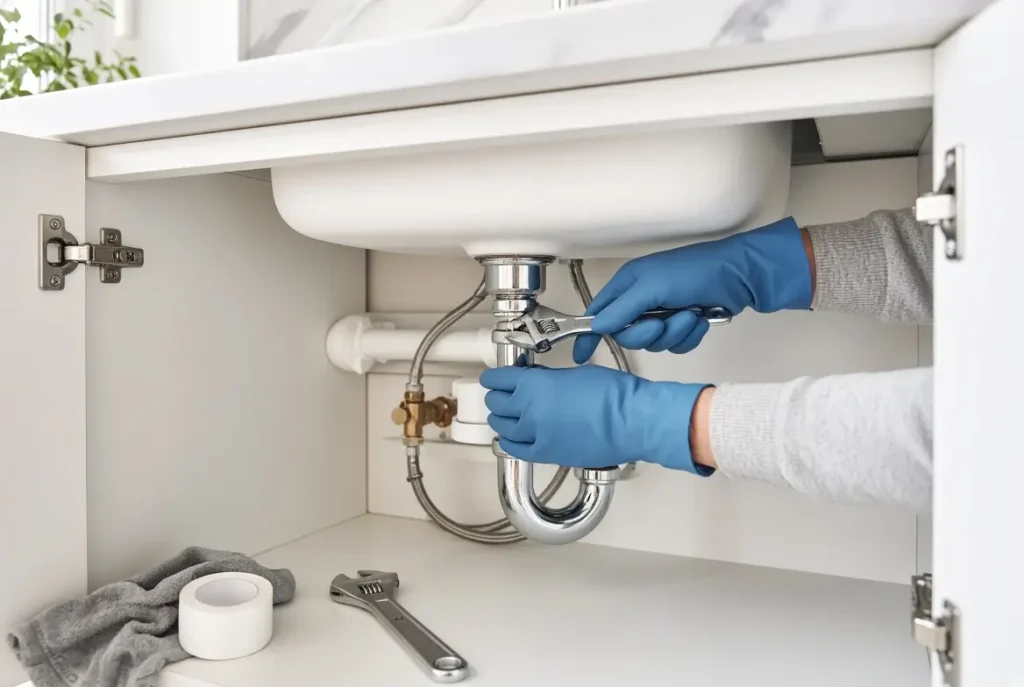
- The P-trap
- Garbage disposal connections
- Dishwasher connections
Water doesn’t always appear directly beneath the source.
It can travel along the outside of a pipe or cabinet before reaching the bottom.
If the cabinet is repeatedly getting wet, don’t simply place a towel underneath it. Determine where the water is coming from.
What Is a P-Trap?
A P-trap is the curved section of drain piping underneath a sink.
Its job is to hold a small amount of water that helps prevent sewer gases from entering the home through the drain.
P-traps can leak because of:
- Loose connections
- Damaged washers
- Cracks
- Corrosion
- Improper installation
- Physical damage
Because the P-trap is usually accessible, it is a common location for relatively small plumbing repairs.
A leaking P-trap should still be addressed promptly because water inside a sink cabinet can damage the cabinet floor and surrounding materials.
Why Is My Water Pressure Low?
Low water pressure can have many causes.
If only one faucet has low pressure, the problem may be localized to that fixture.
Possible causes include:
- A clogged faucet aerator
- Mineral buildup
- A partially closed shutoff valve
- A restricted supply line
- A damaged faucet cartridge
If low pressure affects multiple fixtures throughout the house, the cause may be farther upstream.
Possible causes can include:
- Plumbing restrictions
- A pressure regulator problem
- Corroded plumbing
- A partially closed main valve
- A water supply problem
- A leak
A sudden change in water pressure deserves more attention than a gradual change that has existed for years.
What Is a Plumbing Shutoff Valve?
A shutoff valve controls water flow to a plumbing fixture or section of the home’s plumbing.
You may find shutoff valves underneath:
- Bathroom sinks
- Kitchen sinks
- Toilets
- Washing machines
- Water heaters
Knowing where these valves are located can help limit water damage during a plumbing problem.
Unfortunately, shutoff valves can become difficult to turn after years of use.
A valve that won’t operate properly may need to be replaced.
What Should I Do If a Shutoff Valve Is Leaking?
If a shutoff valve is leaking, don’t keep forcing or twisting it.
If the valve can be safely operated, shut off the water and arrange for the valve to be repaired or replaced.
If you cannot stop the water at the fixture, the home’s main water shutoff may need to be used.
Why Is My Showerhead Dripping?
A showerhead that drips after the water has been turned off may have mineral buildup, a worn component, or a problem with the shower valve.
Sometimes water remaining inside the showerhead drains out shortly after use. That’s different from a showerhead that continues dripping indefinitely.
If the water keeps coming out after the expected drainage period, the valve controlling the shower may need to be inspected.
Why Do My Pipes Make Knocking or Banging Sounds?
Plumbing systems can make different noises for different reasons.
Common sounds include:
- Banging
- Knocking
- Hissing
- Whistling
- Gurgling
- Rattling
- Ticking
Some sounds are related to normal temperature changes or water movement.
Other noises can indicate loose pipes, excessive water pressure, trapped air, or a plumbing restriction.
A new or increasingly loud plumbing noise is worth investigating, particularly if it occurs along with leaks, pressure changes, or other plumbing problems.
What Should I Do If a Pipe Starts Leaking?
If a pipe suddenly begins leaking, your first priority should be controlling the water.
If there is an accessible shutoff valve, turn off the water to that fixture or section of plumbing.
If necessary, shut off the home’s main water supply.
Move belongings away from the affected area and protect flooring or cabinets from additional water.
A temporary patch should not be treated as a permanent plumbing repair.
The damaged pipe, fitting, or connection needs to be properly evaluated and repaired.
Can Small Plumbing Problems Cause Water Damage?
Absolutely.
A plumbing problem doesn’t have to produce a large amount of water to cause damage.
A slow leak underneath a sink can eventually damage:
- Cabinets
- Flooring
- Subflooring
- Drywall
- Baseboards
- Insulation
- Nearby materials
This is why early plumbing repairs are often less expensive than waiting for visible damage to appear.
Can Homeowners Make Small Plumbing Repairs?
Some basic plumbing maintenance is reasonable for homeowners who are comfortable doing the work.
Examples can include:
- Cleaning a faucet aerator
- Replacing a showerhead
- Replacing certain accessible fixture components
- Cleaning a drain
- Replacing a simple faucet component
However, plumbing becomes more complicated when the problem involves hidden pipes, pressurized lines, damaged connections, extensive leaks, or plumbing inside walls.
If you’re not sure what you’re doing, turning a small repair into a major leak can be an expensive lesson.
When Should I Call a Professional for Plumbing Repair?
You should consider professional help when:
- You cannot locate the source of a leak
- A leak is inside a wall
- Water damage is occurring
- Multiple drains are backing up
- Sewage is involved
- A shutoff valve will not operate
- Water pressure suddenly changes throughout the home
- A plumbing repair keeps failing
- A pipe needs to be replaced
- A fixture cannot be repaired properly
- You are uncomfortable performing the repair
Recurring problems are especially important.
If the same faucet keeps leaking or the same drain repeatedly clogs, replacing the same component over and over may not solve the underlying issue.
How Much Does Small Plumbing Repair Cost?
There is no single price for small plumbing repair because the term covers many different jobs.
Replacing a faucet component is very different from repairing a damaged pipe or replacing a shutoff valve.
The final cost can depend on:
- The type of plumbing problem
- The fixture involved
- The parts required
- Accessibility
- Labor
- Extent of damage
- Whether additional damage is present
The most useful first step is determining exactly what needs to be repaired.
A proper diagnosis prevents homeowners from paying for unnecessary work or replacing components that weren’t actually causing the problem.
How Can Detroit Homeowners Prevent Plumbing Problems?
You can’t prevent every plumbing failure, but basic maintenance can help.
Check Under Sinks
Every few months, look inside kitchen and bathroom cabinets for moisture, staining, corrosion, or damaged connections.
Fix Drips Early
A small drip is easier to deal with before it damages surrounding materials.
Know Your Shutoffs
Know where your fixture shutoff valves and main water shutoff are located.
Don’t Put Everything Down the Drain
Grease, wipes, large food particles, and other inappropriate materials can contribute to drain problems.
Don’t Ignore Strange Noises
New banging, hissing, or gurgling may indicate that something has changed in the plumbing system.
Watch Your Water Bill
An unexplained increase in water usage can sometimes indicate a hidden leak.
Don’t Force Stuck Valves
A stuck plumbing valve can break when excessive force is applied.
Small Plumbing Repair vs. Major Plumbing Work
Not every plumbing problem belongs in the same category.
Small plumbing repair generally involves a localized issue such as a faucet, toilet component, shutoff valve, accessible drain, supply line, or minor connection.
Major plumbing work may involve sewer lines, extensive repiping, underground plumbing, major water lines, gas systems, or large sections of the home’s plumbing.
Understanding that difference helps homeowners choose the appropriate professional for the job.
For a handyman service, the focus should remain on minor residential plumbing repairs and fixture-related problems that fall within the services offered.
Frequently Asked Questions About Small Plumbing Repairs
What is the most common plumbing repair?
Leaking faucets, running toilets, slow drains, leaking connections, and faulty plumbing valves are among the most common residential plumbing repairs.
Is a dripping faucet an emergency?
Usually not, but it should still be repaired. A persistent drip wastes water and indicates that a faucet component isn’t functioning correctly.
How do I know if my toilet needs repair?
A toilet that runs continuously, leaks around the base, doesn’t flush properly, rocks when you sit on it, or has other persistent problems should be inspected.
Why does my sink smell like sewage?
A dry trap, drain buildup, blockage, or another plumbing problem can contribute to sewer-like odors. Persistent odors should be investigated rather than masked.
Why does my drain keep clogging?
Recurring clogs can be caused by buildup, improper materials entering the drain, deeper restrictions, or problems farther down the plumbing system.
Can a leaking pipe be repaired without replacing the whole pipe?
Sometimes. If the problem is isolated to a fitting or damaged section, a localized repair may be possible. The condition and material of the existing plumbing determine the appropriate solution.
Should I repair or replace an old plumbing fixture?
Repair may make sense when the fixture is otherwise in good condition and replacement parts are available. Replacement may be more practical when the fixture is heavily corroded, damaged, outdated, or repeatedly failing.
Is low water pressure always a plumbing problem?
No. A clogged faucet aerator or partially closed valve can cause low pressure at one fixture. If pressure is low throughout the home, a larger plumbing or water-supply issue may be involved.
What is the first thing I should do when a plumbing fixture leaks?
Control the water if possible. Use the fixture’s shutoff valve or the home’s main water shutoff if necessary, then determine where the leak is coming from.
When a Small Plumbing Repair Shouldn’t Wait
Most small plumbing problems don’t require panic.
They do require attention.
A dripping faucet, running toilet, slow drain, leaking shutoff valve, or damp cabinet may be telling you that a component has reached the end of its useful life.
Fixing the problem while it is still localized can help prevent water damage and reduce the chance of a much more expensive repair later.
For Detroit-area homeowners, the best approach is simple: identify the source, determine whether the problem can be repaired, and address it before it becomes a larger issue.
Whether the job involves a leaking faucet, toilet repair, sink plumbing, a damaged valve, a minor pipe leak, or another small residential plumbing problem, getting the right repair done the first time is usually better than repeatedly treating the symptoms.
Need Help With a Small Plumbing Repair?
If a plumbing problem is becoming a headache, don’t wait until a small leak becomes water damage.
A professional can evaluate the problem, identify the source, and determine whether a repair or replacement is the better option for your home.